
Ferrule 43
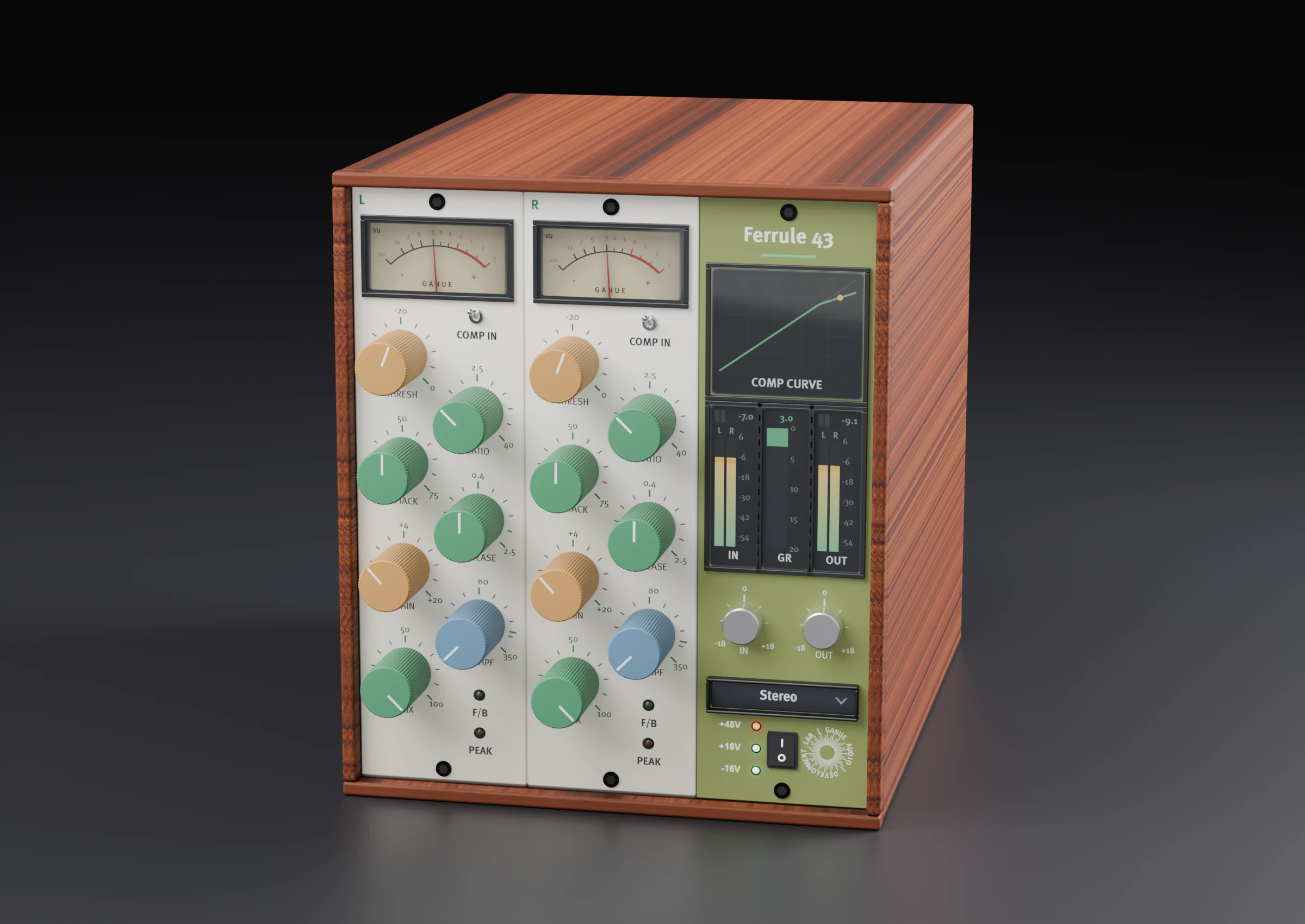
Ferrule 43 is a one-slot channel compressor: a feedforward or feedback VCA compressor with an RMS or peak detector, a soft knee, a high-pass filter on the detector, a MIX control and a colour stage that runs whenever the compressor is in. It runs as a mono or stereo plug-in (Stereo, Summed S/C, Dual Mono, M/S) with a 14-day full trial and an offline licence.
The facts, in numbers
| Compressor | VCA, feedforward or feedback (F/B switch), RMS or peak detector (PEAK switch), soft knee 3.0 dB wide |
|---|---|
| Ranges | THRESH -50 to 0 dBFS; RATIO 1.1:1 to 40:1; ATTACK dial 20 to 75 ms; RELEASE dial 0.1 to 2.5 s; GAIN -6 to +20 dB; MIX 0 to 100 percent; SC HPF OFF or 20 to 350 Hz |
| Colour stage | Even-order, runs with COMP IN; THD at 1 kHz -90.5 dB at -18 dBFS and -74.5 dB at -6 dBFS |
| Oversampling | Off / 2x / 4x / 8x, Minimum or Linear phase; default 2x Minimum |
| Latency | 0 samples with oversampling Off; 3 / 4 / 5 at 2x / 4x / 8x Minimum; 129 / 139 / 142 at Linear phase; Look Ahead adds 5, 10 or 20 ms |
| Presets | 32 factory presets: Init plus 31 starting points in seven categories |
| Stereo | Mono or stereo instance; Stereo, Summed S/C, Dual Mono, M/S; external sidechain input |
| Displays | Comp Curve, GR History and SC EQ pages; IN / GR / OUT meters |
| Bypass | With COMP IN out or the power switch off the output is the input, bit for bit, at the reported latency; the power switch crossfades over 15 ms |
Every control on the strip
Ctrl / Cmd while dragging moves a control in exact steps of its displayed unit.
| COMP IN | Puts the compressor and its colour stage in and out. |
|---|---|
| THRESH, RATIO | THRESH -50 to 0 dBFS (a fresh instance compresses nothing); RATIO 1.1:1 to 40:1. |
| ATTACK, RELEASE | Dials engraved 20 to 75 ms and 0.1 to 2.5 s. They are dial positions, not times: the manual lists the real time constant behind every position. |
| GAIN, MIX | GAIN -6 to +20 dB. MIX blends the uncompressed signal back in, 0 to 100 percent. |
| SC HPF | A high-pass on what the detector hears (OFF, or 20 to 350 Hz). It never filters the audio. |
| F/B, PEAK | F/B lit: the detector listens to the output (feedback). PEAK lit: it reads peaks instead of RMS. |
| Options menu | External or internal key, detection timing (look-behind 5 and 10 ms, look-ahead 5, 10 and 20 ms), Detector OS, Mix Law, Parallel Auto Gain, SOLO of the detector. |
| General section | Display (Comp Curve, GR History, SC EQ), IN / GR / OUT meters, IN and OUT trims +/-18 dB, stereo-mode selector, power switch. UI size 75-200% |
14 days, every feature
The free trial is on the Ferrule 43 Gumroad page: the button below opens it; press Start the free 14-day trial there (price 0) for the Ferrule 43 installers for Windows and macOS. Install, insert Ferrule 43 in your host and press Start Free Trial inside the plug-in: 14 days, full features, full audio quality, no watermark. The clock starts when you press Start Free Trial, not when you download. Each Ferrule product has its own 14 days. When you buy, the same installation unlocks -- nothing to reinstall. Gumroad may ask for an email address to deliver the files.
We do not offer refunds on paid purchases -- the trial is how you decide. Your statutory rights are not affected. Refund policy
What is not perfect, plainly
We ship disclosure, not marketing. These are the known limits of Ferrule 43 1.0.0; the manual carries the full list, and the Ferrule FAQ answers the common questions.
- Changing the stereo mode while the plug-in is processing is a 25 ms crossfade from the old mode to the new one (the old mode keeps running until the new one is ready), so it does not click: with oversampling Off, 2x or 4x minimum phase and 2x linear phase the largest sample-to-sample step was 1.004 times (48 kHz) and 1.006 times (44.1 kHz) that of the signal's own steady stretches; 8x and the other linear-phase settings were held to a looser limit (1.05). The new mode is fully in only after the crossfade. A change while nothing is being heard (the plug-in idle or bypassed) takes effect at once. Stereo <-> Summed S/C is not crossfaded: the routing is the same, only the detector's key changes, and the gain moves at once to the new key's reduction -- a small one-off step.
- After a stereo-mode change where the detector's key itself changes (for example Stereo <-> M/S, Summed S/C <-> Dual Mono), the new mode's gain reduction takes over inside the crossfade, and afterwards the gain matches a never-switched strip within 0.05 dB.
- Switching the stereo mode costs CPU in the block where it happens. The CPU of that block (2x minimum phase (the default oversampling) with Detector OS on and SC HPF at 150 Hz (both off by default), one instance, on a reference PC (an i7-8700), median of five runs, percent of the buffer period; a slower machine reads higher): 192 kHz buffer 16 reads 98 percent, buffer 32 74 percent; 96 kHz buffer 16 68 percent; 48 kHz buffer 16 42 percent, buffer 128 15 percent. The first three are over the 50 percent we aim for, and the first nearly fills the whole buffer. So with a very small buffer at 192 or 96 kHz, a host or machine with no spare time can drop that one buffer: a single click at the moment of the switch, not a continuing load. The cause is not yet found, and we will work on it in a later version. Other oversampling settings, the all-default setting (Detector OS and SC HPF off), sample rates other than 48, 96 and 192 kHz (44.1, 88.2, 176.4, 352.8 and 384 kHz), several instances switching together, and the Look and Summed S/C switches were not re-read for this manual.
- Feedback + PEAK + SC HPF on sustained bass. With F/B and PEAK lit and SC HPF set well above a held bass note (for example 250 Hz against a 60 Hz note), the gain reduction can settle into a slow movement whose phase depends on what was played before: about 1.2 to 1.5 dB at 8:1, about 0.05 dB at 2:1. RMS, feedforward, a lower SC HPF or higher notes do not show it. The unit we analysed does the same in this configuration: its gain reduction moves over the same range (a 10 ms span of about 3.4 dB at 8:1 on both) and the history-dependent difference agrees with Ferrule 43's to within 1.1 dB, so it is kept as part of the behaviour reproduced.
- Aliasing at the default is 1.1 dB short of -100 dBc for a 19 kHz tone at 44.1 kHz with no gain reduction; with oversampling Off the colour stage folds as the analysed unit does (manual section 10.2).
- The peak detector on very high tones modulates the gain unless Detector OS is on (manual section 10.2); Detector OS adds slightly more reduction on very high tones and a slightly later true-peak reading (manual section 7.4).
- Minimum-phase switching dip during the 15 ms hand-over of COMP IN or the power switch with oversampling on (manual section 10.3).
- Changing the oversampling while the plug-in is bypassed (by the host's bypass, or with COMP IN out) mutes the output for a moment, the same mute as when the plug-in is processing (manual section 10): during the switch the bypassed signal is not passed through untouched. There is no click. We will look at this in a later version.
- MIX 0 % with minimum-phase oversampling is not a pure delay (manual section 6.6).
- The reported latency is nominal with minimum-phase oversampling (manual section 10.1).
- CPU: 2x with Detector OS, 4x, 8x and linear phase exceed this product's CPU budget (manual section 10.4).
- Parameter moves glide over 10 ms (GAIN settles in about 10 ms); very fast automation is smoothed (manual section 12).
- SOLO needs COMP IN in; after the strip has been idle it returns once its delay line has refilled; with an external key in M/S it is not decoded (manual section 7.5).
- The GR displays read the deepest reduction of each processing block, so they can read slightly deeper than the reduction at the block's last sample.
- DC passes the audio path (manual section 12).
- Opening the editor the first time in a session takes about 0.6 s (the knob images are decoded); reopening takes a few milliseconds.
- Unlicensed and offline renders. Without a trial or license the plug-in passes audio dry, including during an offline render (manual section 13). Already-open instances do not re-read a license you add while they are loaded.
- Not measured for this manual: playback in every host on every platform. The primary verification host is Studio One, and Logic on macOS. Every figure here is a reading of the Windows build; none was measured on macOS. Sidechain routing, SOLO and the gain-reduction display were not checked by hand in Studio One for this manual.
- A preset load costs one block of extra processing time, up to about 36 percent of a 192 kHz, 32-sample block (the change is spread over slices). After a load that switches COMP IN on in a strip that was idle, the compressor fades in about 60 ms after the load: it first gathers 60 ms of input so that it can start at its settled gain reduction.
- High Q at 60 Hz and below on the SC EQ. A band at 60 Hz or lower with a high Q, switched on by a large settings change, cannot settle inside the 85 ms history the change has, so the detector reads a short dip: with a +12 dB low shelf at 60 Hz and a 60 Hz tone it measured about 0.5 dB at Q 4, 2.1 dB (feedback) and 1.6 dB (feedforward) at Q 8, and 3.5 dB and 3.9 dB at Q 24. Q 2 and below is inside the line.
- Sidechain EQ and SC HPF after a Look, source or settings change. The detector's key is rebuilt in slices, and a few cases still read a small step: one at 96 or 192 kHz at the end of the rebuild (smaller than the step with no filter on), four step measurements equal to the no-filter value, and, at 192 kHz with Detector OS at 4x or 8x, a Look made shallower is not rebuilt. With Linear oversampling phase an SC EQ band can dip deeper than with minimum phase; the cause is not understood yet. The SC EQ page draws the host-rate design while Detector OS runs the EQ at its own rate, so near the top of the band the two differ (manual section 7.6).
- A preset load is one step. A factory preset, a user preset, Reset to Init and a restored session each write every parameter they set once, straight to its final value, and the audio engine takes the whole set up at a single buffer boundary, so no buffer plays a half-loaded mix of the old and new settings. Host automation that arrives while a load is being applied is taken up as soon as the load ends (a few milliseconds).
- The level just after a preset load. In a test with steady tones (every factory preset loaded over Init and over its neighbours in the list, both directions; oversampling Off and 2x) no load rose more than 0.44 dB above the louder of the two settings (0.69 dB on music), and the level did not dip by more than 1.3 dB: a preset load goes straight to the new settings' settled gain reduction within 10 ms.
- A switch that changes the latency (the oversampling mode or phase and, where this product has them, the Bloom engine, Flutter or Look) fades the output out over 5 ms, holds silence and fades it back in over 5 ms. For an oversampling change the whole mute lasts about 21 ms into minimum phase or Off and about 22 to 24 ms into linear phase at 44.1 and 48 kHz, about 18 and 19 ms at 96 kHz. If the IN trim was moved within the last 50 ms, the silence lasts until that move has finished (up to about 50 ms longer). In a test of such switches on every Ferrule product the largest sample-to-sample step on a 40 Hz tone read at most 1.086 times the signal's own (the line is 1.10). Content below 24 Hz inside the mute is not covered by that reading.
- At 192 kHz with a 16-sample buffer the one buffer in which an oversampling-mode change swaps the oversampling chain takes longer than the buffer's period (a possible dropout at that moment on a host that cannot absorb it; the output is muted by the fade there). Measured on Ferrule Pre: Off to 8x linear 355 percent of the period, the worst other pair 341 percent, the smallest pairs 170 to 177 percent. The code is shared; the other products were not read on this.
- The IN and OUT trims glide in dB over 50 ms, with no corner at either end: a move that is reversed halfway turns from where it is, and a move never passes its target. Moving IN and OUT in opposite directions at the same moment does not bump the level. In a test of single trim moves (60 Hz, 900 Hz and 8 kHz tones) the largest change of slope read at most 1.02 times the signal's own on every Ferrule product (the line is 1.10); a switch that changes the latency, made inside an IN move, adds no dip of its own.
- Host bypass and re-engaging. At minimum-phase oversampling (host rate below 150 kHz) the crossfades between the dry and the processed signal match the dry path's phase while blending. The price is a brief high-frequency dip: for this product its own reading was not taken. Linear phase, oversampling Off and rates of 150 kHz and up are not matched.
- A parameter change made while the stereo mode is handing over is heard only from the end of the hand-over ramp (measured on Ferrule Pre: up to 110 to 119 ms at 48 kHz with 8x oversampling, 467 to 476 ms at 192 kHz; the code is shared, this product's own figures were not read).
Formats & requirements
| Developer | GANUE Audio |
|---|---|
| Version | 1.0.0 |
| Windows | Windows 10 or later (64-bit): VST3, AAX |
| macOS | macOS 11.0 or later: VST3, AU, AAX (one Universal build, Apple Silicon and Intel; signed and notarized) |
| Standalone | None |
| Licence | Offline licence file, no iLok, no account, no online activation, no expiry |
| Trial | 14 days, full features |
| Price | USD 19 until Nov 30, 2026, then USD 29USD 29. Also in the Ferrule Modern Collection and the Ferrule Complete Collection |
| SHA-256, Windows installer | 0e32a8152b0b721cf9d11d4bb39cd6bb86061766bc1c80ca60dc0715902ffc74 |
| SHA-256, macOS installer | 4828e5deb7bc88e8bcdfbd2a6dc383081512cb4fe7031221e2d7a18be70b719f |
Get Ferrule 43
USD 19 until Nov 30, 2026, then USD 29USD 29. Windows & macOS. 14-day full trial first.
Also in the Ferrule Modern Collection (Ferrule 51 (free) with 33, 35, 42 and 43): USD 49 until Nov 30, 2026, then USD 69USD 69; and in the Ferrule Complete Collection (all ten plug-ins): USD 89 until Nov 30, 2026, then USD 119USD 119.
Checkout is handled by Gumroad. Your licence file and the installer links arrive in a separate email from [email protected]; drag the file onto the Ferrule 43 window and it unlocks, offline. The PDF manual is included. EULA
By continuing to checkout you agree to the EULA and the Refund Policy.